Emory Bortz
The Crying of Lot 49Emory Bortz is a professor and specialist in the historical playwright Richard Wharfinger whose research becomes one of Oedipa Maas’s principal routes into the history of Tristero. He recognizes that the line about Trystero in her paperback does not belong to his edition of Wharfinger, and his knowledge of the play and its source material helps Oedipa assemble a history from scattered documents. Yet Bortz supplies neither a final explanation nor a secure boundary between evidence and conjecture: his scholarship advances her investigation while leaving the organization’s survival and reach unresolved.
Identity and Background
Bortz teaches at San Narciso College, an institution heavily endowed by Pierce Inverarity. His work concerns Wharfinger, including an edition he published in 1957 and a new, updated edition he expects to appear the following year. He describes the playwright as someone who kept a commonplace book, a record of quotations and reading that became a source for later scholarship. Bortz has gathered related materials in a locked glass case of old books, protecting them from children who might handle them.
The domestic scene in which Oedipa meets him is far from a formal academic interview. His wife, Grace, explains that he is outside with students in what she calls a long-running, organized joke: he sits in the sun, drinks beer, and throws bottles at seagulls. Oedipa finds him half in a hammock with three graduate students and a pile of empty bottles. She asks about the historical Wharfinger rather than merely the playwright’s words, but Bortz insists that the historical person is dead and that what remains available for discussion is language. His answer establishes both his scholarly method and its limit: the past must be approached through surviving texts.
The Altered Play and Driblette
Oedipa brings Bortz the paperback of The Courier’s Tragedy and quotes its line about a tryst with Trystero. Bortz reacts with surprise, asking how she got into the Vatican Library, then examines the book and realizes that he and Wharfinger have been pirated. The edition has been altered in a way he describes as a reverse bowdlerization; its publisher is K. da Chingado and Company, and Bortz notices offset printing, misprints, and corruption in the text. He wonders how whoever produced this version obtained access to the Vatican material.
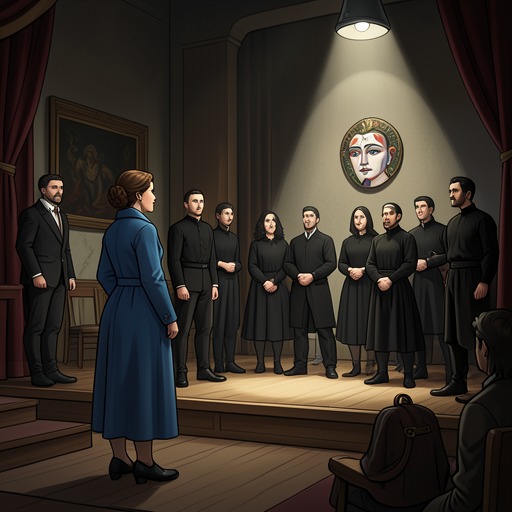
Bortz distinguishes the altered book from Randolph Driblette’s production at the Tank Theatre. He considers Driblette’s staging virtuous and describes him as unusually faithful not to the words alone, but to the invisible field or spirit surrounding the play. In Bortz’s view, Driblette was the person most capable of evoking the historical Wharfinger and the world of the play as it might have existed in its author’s mind. When Bortz speaks of Driblette in the past tense, Oedipa realizes that he has died; Bortz’s account thus confirms the loss of the director whose interpretation she had hoped to question.
The pornographic version Bortz says he saw at the Vatican Library in 1961 provides a separate textual strand. In the version he describes, Pasquale, one of the villains, marries his mother, and the work includes a scene on their wedding night. Bortz notes that the artist is anonymous and that the poet who rewrote the play is anonymous as well. He also points to the figure of Death recurring in the background and characterizes the work’s moral anger as medieval in spirit, possibly resembling that of the Scurvhamites. These observations connect the textual alteration to a religious and ideological history, but do not establish who made the version or exactly why.
Scurvhamite Theology and Tristero
Bortz explains that Robert Scurvham founded a strict Puritan sect during the reign of Charles I. Its central concern was predestination: the Scurvhamites imagined Creation as an intricate machine, with one part governed by God’s will and the rest driven by an opposing, blind principle leading toward eternal death. The sect sought converts to its purposeful, Godly community, but its members became fascinated by the doomed world outside it. One by one, that spectacle drew them away until even Scurvham himself was the last to leave.
Bortz reads the Trystero line in the play through this theology. In his interpretation, the hallowed stars represent God’s will, which cannot protect someone appointed to meet Trystero. Trystero could therefore stand for the brute, impersonal Other that keeps the non-Scurvhamite universe running. This is Bortz’s reading, not a proven account of the organization’s nature. When Oedipa asks what Tristero was, he says that several new areas of inquiry have opened since his 1957 edition and points to older source material. He presents the history as incomplete, with his forthcoming updated edition still in preparation.
Historical Research and Its Limits
Bortz’s materials help Oedipa begin piecing together Tristero’s origins. A central source is a weathered book titled An Account of the Singular Peregrinations of Dr. Diocletian Blobb among the Italians, which Bortz keeps with his Wharfinger materials. He explains that Wharfinger maintained a commonplace book and that the playwright’s notes preserve references to Blobb’s account. Blobb’s story, together with clues from other sources, provides a route into the organization’s earlier history.
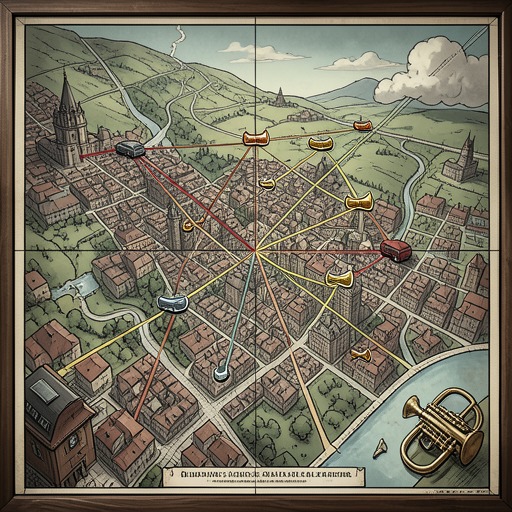
Oedipa’s reconstruction draws on obscure philatelic journals supplied by Genghis Cohen, a footnote in Motley’s Rise of the Dutch Republic, an old pamphlet on the roots of modern anarchism, sermons by Blobb’s brother Augustine, and Blobb’s own clues. In the account that emerges, political upheaval in the Low Countries in 1577 unsettles the Thurn and Taxis postal monopoly. Jan Hinckart replaces Leonard I, Baron of Taxis, as Grand Master of the Post; Hernando Joaquín de Tristero y Calavera then enters the dispute, claiming kinship with Hinckart and the right to inherit his position. Bortz’s scholarship is therefore a bridge between the play’s obscure name and a political conflict over authority and postal power, although the source fragments do not make every part of the history certain.
Bortz also proposes that periods of crisis in the Thurn and Taxis system might have had mirror images in a hidden Tristero state. He uses this theory to address the mystery of why Tristero appears in print only around the middle of the seventeenth century and why the play could hint at a rival without provoking retaliation. He suggests that a serious crisis within Tristero might account for the silence, and perhaps for the organization’s failure to kill Dr. Blobb. The proposal gives Oedipa a framework for interpreting gaps in the record, but remains conjectural; Bortz’s explanations often point toward questions rather than closing them.
Historical Afterlife and Narrative Role
Bortz’s account follows the changing meaning of Tristero as the authority of the Thurn and Taxis system weakens. After the Holy Roman Empire ends, the postal monopoly loses the source of its legitimacy. In Bortz’s reconstruction, uncertainty about the identity and reach of its opponent could make Tristero seem like a blind, automatic force responsible for deaths among riders, disasters on roads, new local competitors, and the system’s decline. Over the next century and a half, that impersonal fear recedes as the rival comes to be understood as human. By 1795, some even suggested that Tristero had staged the French Revolution to bring about the proclamation ending the Thurn and Taxis monopoly in France and the Low Countries; Oedipa immediately asks who made that suggestion, underscoring how uncertain the historical claims remain.
Bortz’s importance rests on the tension between documentary research and imaginative interpretation. He can identify an altered text, explain the sources behind Wharfinger’s work, and assemble historical fragments, but his mirror-image theory and explanations for the gaps are hypotheses. His own institutional connection further unsettles Oedipa: San Narciso College is funded by Inverarity, and she recognizes that Bortz, like other people and places along her route, may be connected to the estate. She wonders whether the people in the apparent network are Inverarity’s employees, willing accomplices, or participants in a vast practical joke. The text does not settle that suspicion. Bortz remains both a valuable guide to the archival trail and one of the figures whose presence makes the trail harder for Oedipa to separate from the possibility of an elaborate plot.